

Defining roles and responsibilities in a BIM Execution Plan (BEP) is a critical step that is often underestimated. After establishing BIM Uses and deliverables, it is essential to design a team structure aligned with the project’s characteristics, which may vary depending on complexity, sector, and use of BIM. Team structures can differ from traditional organizational roles, requiring flexibility and careful planning. The definitions presented are based on practical experience and lessons learned, recognizing that different projects may demand different approaches.
It is important to emphasize that these concepts are not absolute truths, but rather lessons learned over years of experience using BIM in engineering projects, whether as a designer or BIM coordinator. Different organizations and project contexts may lead to different interpretations. Therefore, it is essential to continuously incorporate lessons learned and refine strategies to achieve increasingly efficient engineering practices.
Another important aspect is that the BEP should not be treated as a static document. It must evolve throughout the project lifecycle, reflecting adjustments in team structure, processes, and responsibilities as new challenges arise. This dynamic nature reinforces the importance of clearly defined roles, ensuring that all participants understand their responsibilities at each stage of the project.
This post was written by BIM Corner’s Guest Author, Guilherme Guignone.
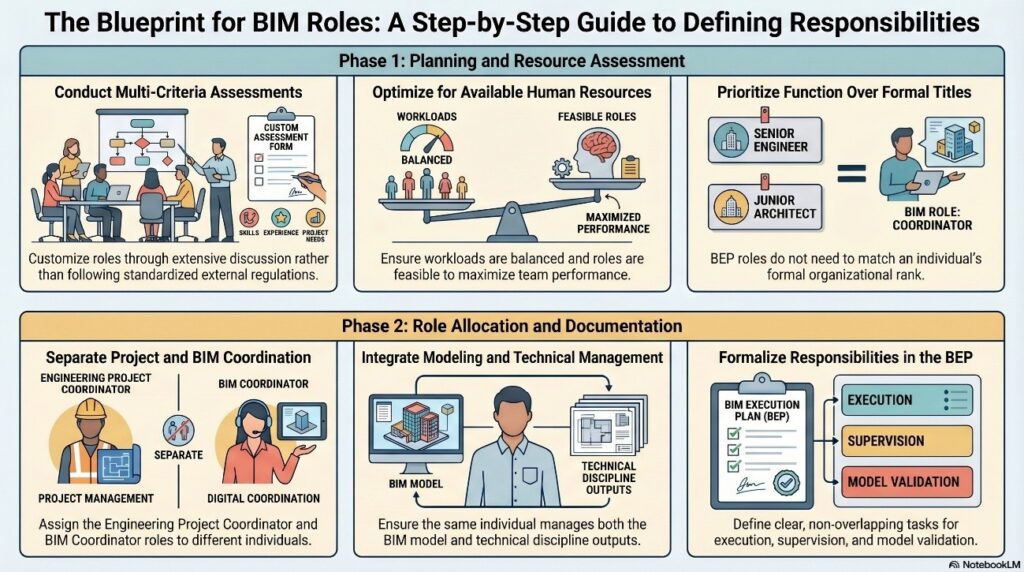
Table of contents
1. Why is it essential to carefully design roles and responsibilities?
2. What variables influence team structure?
3. What are the fundamental roles in a BIM project?
4. What are the differences between BIM roles?
5. Can the modeler also be the Discipline Responsible Engineer?
6. What are the key responsibilities of each role?
7. Should the Project Coordinator and BIM Coordinator be the same person?
1. Why is it essential to carefully design roles and responsibilities?
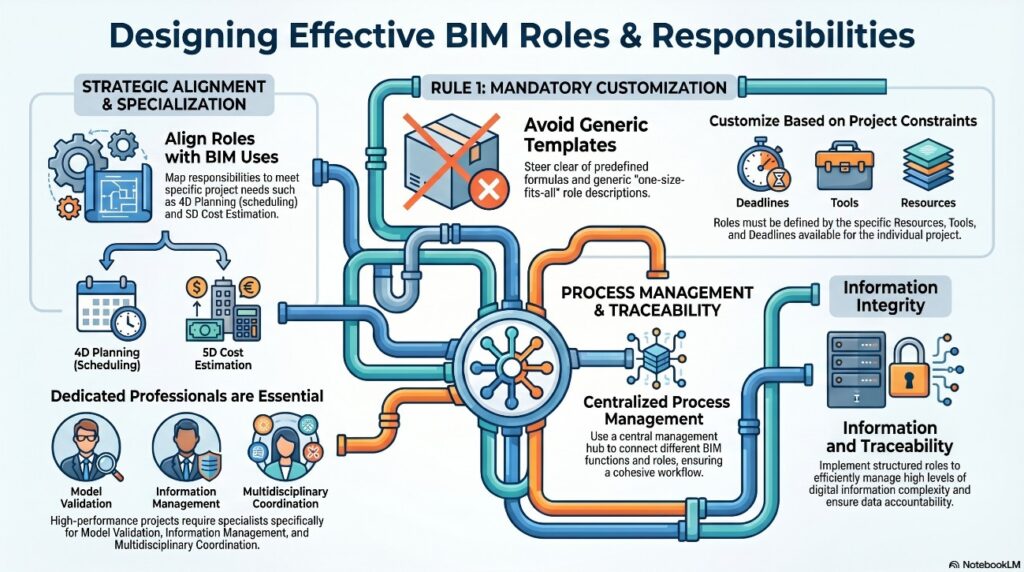
It is essential that roles and responsibilities are designed in accordance with the BIM Uses planned for the project and that these responsibilities are carried out by professionals who are truly proficient in them. A project that includes BIM for discipline models, technical documentation, and quantity extraction will require a different team structure than a project that also includes BIM 4D planning or BIM 5D cost estimation.
Each BIM Use introduces specific demands related to modeling, information management, validation, and coordination. Therefore, the design of roles must consider the level of complexity of these demands. Experience has shown that it is important to have a dedicated professional responsible for validating BIM models in accordance with the BEP, as well as a professional with strong multidisciplinary engineering knowledge, leadership skills, and the ability to integrate different technical perspectives.
In addition, the increasing complexity of digital information requires a more structured approach to responsibility allocation. The volume of data generated in BIM environments demands rigorous control, traceability, and validation processes, which can only be achieved through well-defined roles.
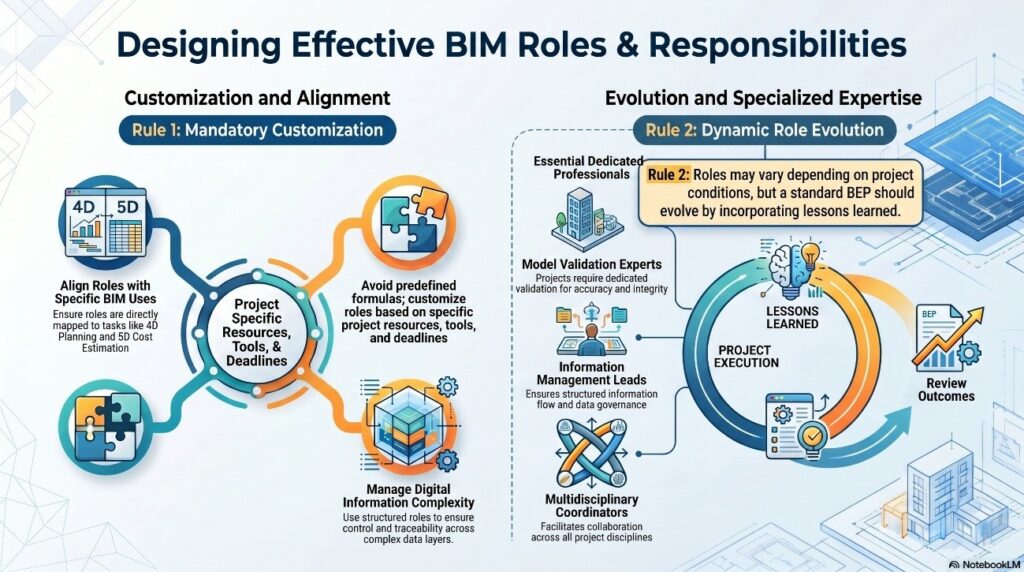
There is no predefined formula for defining roles. Each project requires a customized strategy that considers organizational structure, available tools, human resources, deadlines, and expected deliverables. As projects evolve, organizations should incorporate lessons learned into their BEP, improving their internal processes over time.
Rule 1: Do not design roles and responsibilities based solely on standardized rules; they must be customized through careful analysis of each project.
2. What variables influence team structure?
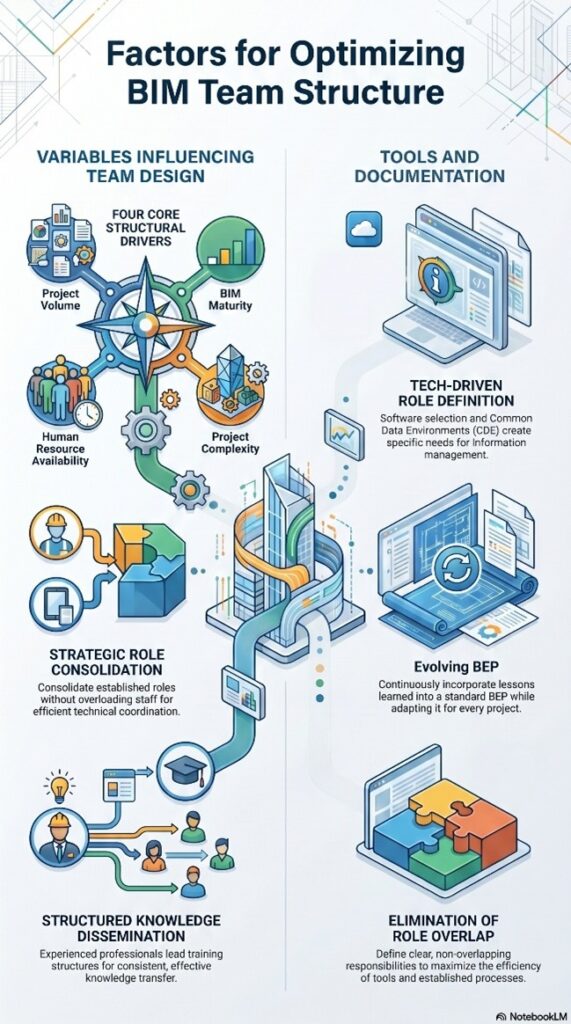
The definition of team structure depends on several variables, including the number of projects in progress, the availability of human resources, the maturity of BIM processes within the organization, and the complexity of the project.
It is important to consolidate roles that are already working well within the organization, but without overloading professionals. For example, an Engineering Project Coordinator responsible for integrating disciplines may only be able to efficiently manage a limited number of projects. Overloading this role can compromise both technical coordination and decision-making quality.
Organizations should invest in knowledge dissemination by creating training structures that enable new professionals to perform efficiently. These training activities should be conducted by experienced professionals, ensuring that knowledge is transferred effectively and consistently across teams.
Another relevant factor is the availability and integration of technological tools. The selection of software and platforms directly impacts workflows and may influence the need for specific roles or competencies within the team. The Common Data Environment (CDE), for example, requires clear responsibilities for information management and control.
The BEP should evolve continuously, incorporating lessons learned from previous projects. However, it must always be adapted to the specific characteristics of each new project. It is not appropriate to adopt a BEP from another organization without reflection and adaptation.
Roles must be clearly defined, without overlap, and understood by all team members. They should also be designed to maximize the use of available technological tools and established processes, ensuring efficiency and productivity.
Rule 2: Roles may vary depending on project conditions, but a standard BEP should evolve by incorporating lessons learned.
3. What are the fundamental roles in a BIM project?
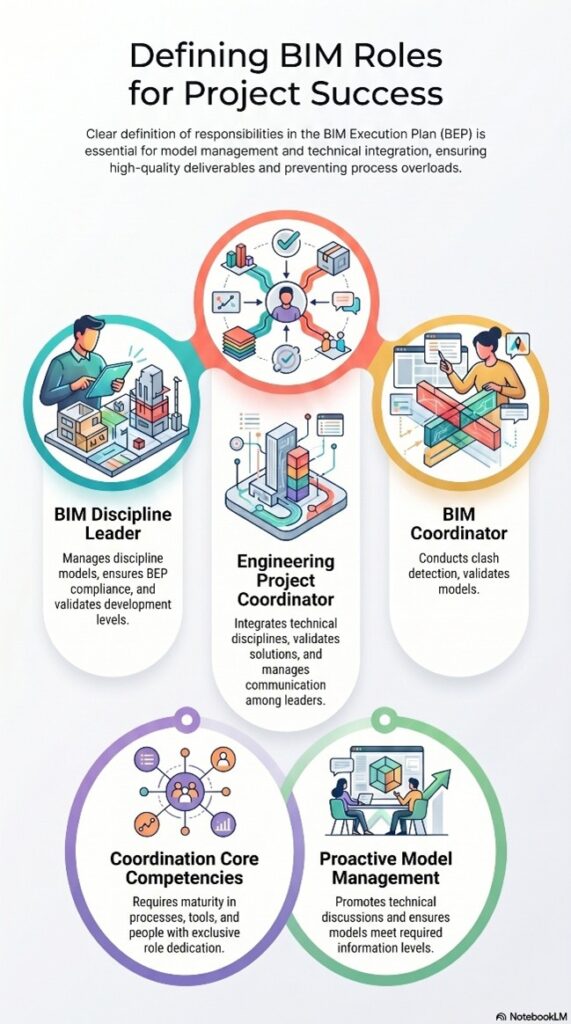
Experience with BIM projects shows that engineering projects typically require a core structure composed of at least four roles: Modeler or Technical Manager of disciplines, BIM Discipline Leader, Engineering Project Coordinator, and BIM Coordinator.
The BIM Discipline Leader is responsible for managing the work of their discipline and ensuring that information is correctly produced and shared according to the BEP. In multidisciplinary projects, it is common to have BIM leaders for architecture, structures, mechanical systems, plumbing, electrical systems, and other disciplines.
However, experience shows that there are often deficiencies in integration between disciplines. For example, communication between structural and plumbing teams may not be efficient. Therefore, it is necessary to have a professional responsible for integrating these disciplines from a technical standpoint.
The Engineering Project Coordinator fulfills this role by conducting interdisciplinary meetings focused on resolving technical issues and aligning engineering solutions. This professional ensures that the project evolves coherently from a technical perspective, minimizing conflicts and inconsistencies.
On the other hand, the BIM Coordinator is responsible for model validation, coordination, and quality control. This includes performing standardized and routine inspections of BIM models to ensure compliance with the BEP, as well as identifying inconsistencies, missing information, and potential clashes.
Each of these roles requires specific competencies. It is often not feasible to find a single professional with deep expertise in both multidisciplinary engineering and BIM processes. Additionally, combining roles may lead to overload and reduced efficiency.
The quality of BIM deliverables depends directly on the quality of the models. Poorly constructed models can lead to errors in quantities, budgets, planning, and technical solutions, generating risks for the entire project lifecycle.
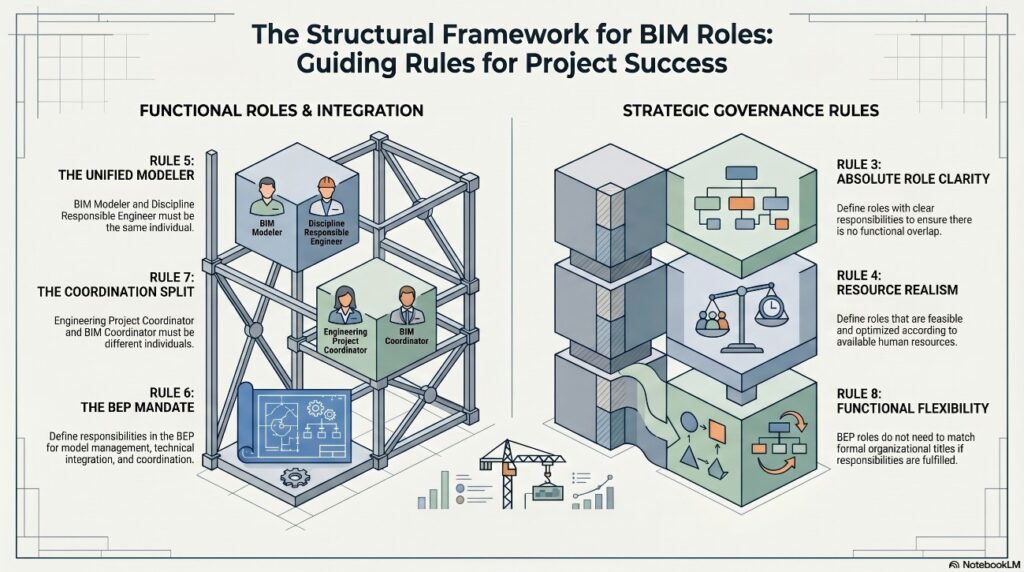
Rule 3: Define roles with clear responsibilities and no overlap.
4. What are the differences between BIM roles?
There is no global consensus on the definition of BIM roles. Standards and references indicate that nomenclature may vary, but the most important aspect is the correct definition of responsibilities and functions.
The BIM Manager operates at the organizational level and is responsible for implementing BIM methodology, developing standards, training teams, and improving organizational maturity.
The BIM Coordinator operates at the project level and is responsible for executing the BEP, validating models, coordinating information, performing clash detection, and leading coordination meetings.
The Engineering Project Coordinator focuses on technical integration between disciplines, supporting decision-making related to engineering solutions and ensuring compatibility between systems.
Modelers and Technical Managers are responsible for developing discipline models and ensuring their technical accuracy, as well as generating all necessary outputs derived from the model.
The key point is that roles must be defined based on project needs and available resources, ensuring feasibility, clarity, and efficiency in execution.
Rule 4: Define roles that are feasible and optimized according to available human resources.
5. Can the modeler also be the Discipline Responsible Engineer?
In traditional CAD workflows, it was common to separate professionals responsible for drawing production from those responsible for technical decisions. However, BIM introduces a different paradigm, where models contain both geometric and non-graphic information and serve as the basis for all project outputs.
With BIM, all technical information used in construction, including documentation, quantities, and specifications, is derived directly from the model. This increases the responsibility of those who develop and manage the model.
Efficient communication is a fundamental pillar of BIM. When model development and technical responsibility are separated, communication failures may occur, leading to inconsistencies, rework, and errors in deliverables.
Therefore, there is a growing consensus that the modeler and the technical manager should be the same individual within each discipline. This ensures direct responsibility for the model and its outputs, improving consistency, reliability, and accountability.
Rule 5: The BIM Modeler and the Discipline Responsible Engineer must be the same individual.
6. What are the key responsibilities of each role?
Clearly defining responsibilities is essential for ensuring efficient BIM processes and high-quality deliverables.
The BIM Discipline Leader is responsible for managing discipline models, ensuring compliance with the BEP, validating development levels, performing audits before deliveries, and controlling model versions.
The Engineering Project Coordinator is responsible for integrating disciplines from a technical perspective, validating engineering solutions, conducting coordination meetings, and managing communication among discipline leaders.
The BIM Coordinator is responsible for model validation, coordination, clash detection, report generation, and ensuring compliance with the BEP.
This role requires maturity in three key areas: processes, technological tools, and people. The BIM Coordinator must proactively analyze models, promote technical discussions, and ensure that models meet the required levels of development and information.
It is recommended that the BIM Coordinator be dedicated exclusively to BIM-related activities to avoid overload and ensure process efficiency.
Rule 6: Define responsibilities in the BEP to ensure model management, technical integration, and coordination.
7. Should the Project Coordinator and BIM Coordinator be the same person?
Experience shows that, especially in medium and high complexity projects, these roles should be performed by different individuals.
In some organizations, BIM responsibilities are simply added to the existing duties of the Engineering Project Coordinator. This often results in overload and reduced performance in both technical coordination and BIM processes.
The competencies required for these roles are different. The Engineering Project Coordinator focuses on technical integration and engineering solutions, while the BIM Coordinator focuses on model validation and process control.
Defining roles should be based on project demands rather than job titles. Simplicity and clarity are essential, and roles should only be created when there is a real need.
Rule 7: The Engineering Project Coordinator and the BIM Coordinator must be different individuals.
8. Should BEP roles match organizational roles?
The primary concern is that roles are appropriate for the BIM Uses required by the project.
It is common for project roles defined in the BEP to differ from formal roles within the organization. This is not a problem, as long as responsibilities are clearly defined and effectively executed.
Project-specific roles focus on meeting the demands of a particular project, while organizational roles address broader institutional responsibilities.
The key aspect is to ensure that responsibilities are well understood by all team members and that there is no ambiguity in their execution.
Rule 8: BEP roles do not need to match formal organizational roles, provided responsibilities are clearly defined and fulfilled.
Conclusion
Properly structuring roles and responsibilities is essential for the success of BIM projects. The BIM Coordinator plays a key role in defining strategies and ensuring compliance with the BEP, while the BEP itself must be tailored to each project and used as a continuous reference.
The separation of roles, especially between the BIM Coordinator and the Engineering Project Coordinator, is fundamental to maintaining efficiency and quality. Overloading professionals or poorly defining responsibilities can compromise both the BIM process and engineering outcomes.
Ultimately, the success of BIM implementation depends on clear role definitions, alignment among team members, and a strong focus on model quality throughout the project lifecycle.
Movie summary
The video presented in this article was generated and summarized using Google NotebookLM, based on the structured content and data developed throughout this study. The tool was used to support the synthesis and visualization of key concepts, aiming to enhance the communication of the proposed workflow.
This post was written by BIM Corner’s Guest Author, Guilherme Guignone.