
Ever signed a contract for a BIM project only to realize you have no idea what data the client actually expects?
Or worse – you are the client, and you just received BIM models that are completely useless for your facility management software. But you cannot do anything with it because… The model meets your vague requirements.
This is what happens when you don’t have Exchange Information Requirements (EIR) at all or haven’t thought it through.
We have published dozens of articles on BIM Corner, but we never wrote a proper guide on Exchange Information Requirements (EIR). Let's fix that today.
The EIR is the foundation of any ISO 19650 project. We previously covered how it fits into the bigger picture of information requirements. You can catch up on that guide here.
Today, we go deeper. This is the first post in our new series: Explaining Exchange Information Requirements. Consider this your ultimate ISO 19650 information requirements guide.
What is EIR in BIM?
Think of the EIR as your project rulebook. It contains the goals and gives strict instructions to everyone bidding on your project.
In short, an EIR BIM document tells the delivery team exactly what data to deliver, and when. It is the absolute core of your BIM information requirements.
The client (appointing party) creates this document for the main contractor (lead appointed party).
The client needs this specific information to run the project during design and construction. More importantly, they need it to manage the facility later.
The EIR is a binding contractual document. Once signed, every stakeholder must follow it. This is why you must have your EIR ready and signed before your tender even starts.
The core aspects of an EIR
According to the ISO 19650 series, your EIR must establish three main aspects of project information production.
Managerial and commercial aspects
"The managerial and commercial aspects should include the information standard and the production methods and procedures to be implemented by the delivery team."
These aspects dictate the rules of play. They define how the building owner will evaluate the incoming data.
Examples of these aspects include:
- Establishing naming conventions to be followed on the project (appointment).
- Defining the use (or specify requirements for) of the Common Data Environment (CDE) process and solutions. More about CDE: CDE within ISO 19650.
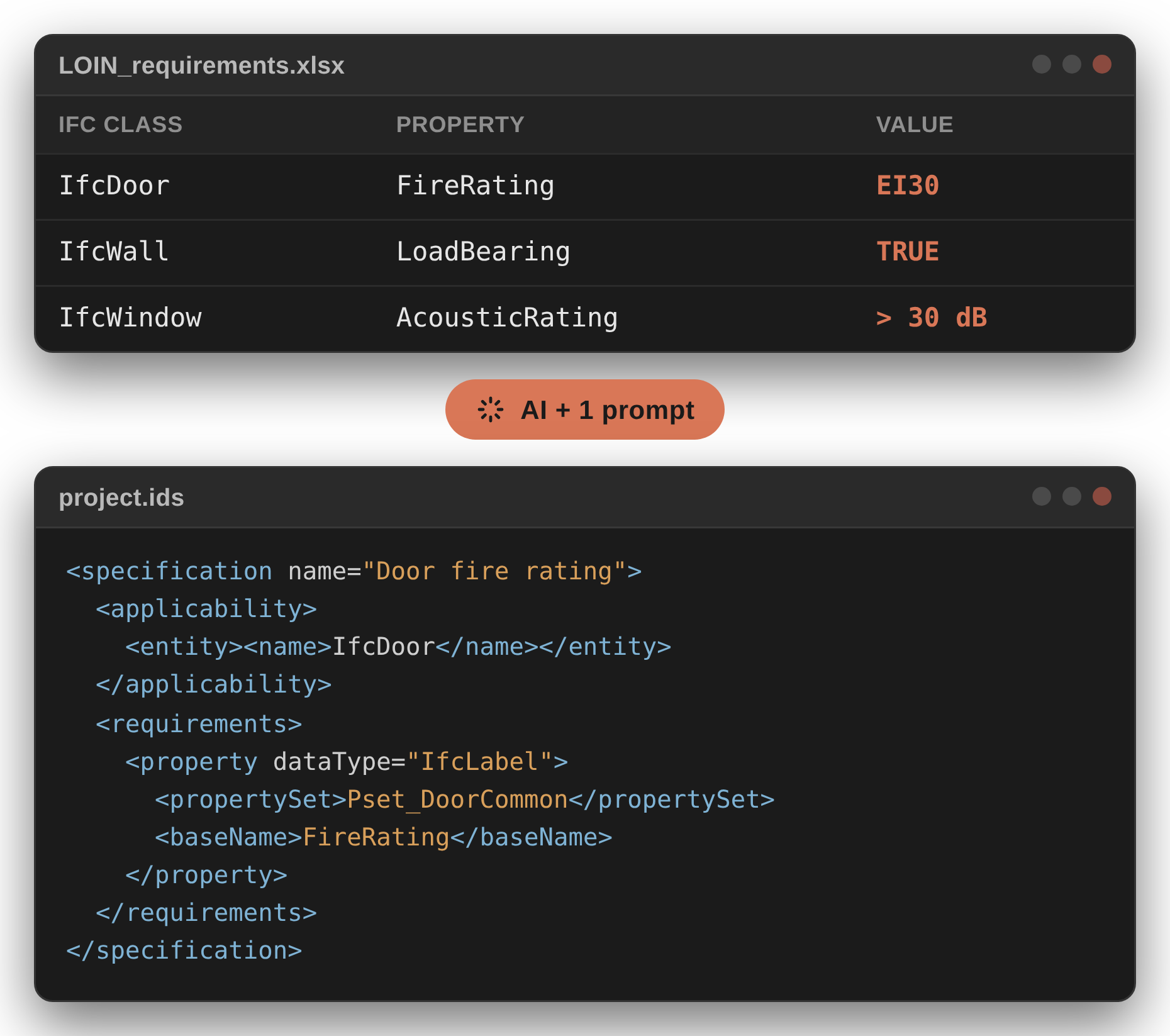
- Acceptance criteria, i.e. setting the information compliance rules. When applied to structured information, we can automate these checks to see if the exported IFC actually matches the requirements. This can be done for example via IDS (IDS guide on BIM Corner).
Technical aspects
"The technical aspects of the EIR should specify those detailed pieces of information needed to answer the PIR."
This part translates high-level business needs into technical deliverables. You must define the quality, quantity, and granularity of the information you need. In ISO terms, we call this the Level of Information Need (LOIN).
The data side of BIM
Practical AI and BIM workflows. The LOIN to IDS pack comes with the first email.
What goes inside an EIR?
When you build an EIR, you have to ask hard questions about what the delivery team must produce.
Information purposes
Start by defining your purposes. The purpose is the most important element because the purpose drives the goals, and the goals drive the specific information requirements.
Information must be created for a specific reason so that it can be actively used by the receiver (building owner). It has to answer the question “why do we need that information delivered”? For example, a purpose might involve actively using BIM models during Facility Management.
Answering foundational questions can set out a ground for the scope of the BIM implementation on the project. Some examples:
| Question | Answer |
|---|---|
| Why do we have digital goals? | We want to use this digital data during the operational phase of the building. |
| How do we increase project delivery efficiency? | By coordinating the design and managing the model handover from the designer to the contractor. |
| Do we want to build a Digital Twin? | Yes, we want to establish the Asset Information Model (AIM) at handover. |
| Do we need 3D models on the construction site? | No, the site team will work from 2D drawings. |
There are dozens of questions to answer. Your scope can range from a simple CDE implementation to a complex BIM Stage 3 delivery.
Goals and objectives
Your EIR must communicate clear goals to the delivery team. These goals tell the team what to do, how to do it, and when.
Defining your goals also helps you decide who owns the data. Some clients want to own the CDE and the standards. Others are happy to let the contractor use their own systems.
Some questions worth considering are:
Goals:
- What are our digital goals?
- What do we understand by the term “Digital Twin”?
- Do we need a functioning CDE during the operation of the facility?
- What CAFM system will we use after handover?
- Will we manage the facility solely using models? Or models and a database?
- What (if any) are our specific sustainability goals (e.g. tracking carbon emissions during the project lifecycle?)
Ownership:
- Do we want to own the Common Data Environment process, or do we hand that over to the contractors?
- Do we want to use our standards and naming conventions or do we hand that over to contractors?
Here is how you translate high-level purposes into clear goals:
| Purpose | Goal |
|---|---|
| Increase project efficiency | Reduce email traffic. Use a centralized task management platform. |
| Encourage collaboration across the entire design team. | |
| Give stakeholders access to the right information at the right time. | |
| Build a Digital Twin at handover | Deliver clean, usable asset data when construction finishes. |
| Define the CAFM system before the tender starts. |
Objectives
What is the difference between goals and objectives in EIR? Let's make it simple: Goals are your high-level targets. Objectives are the specific, actionable steps from which we create requirements. They answer "how" and "when."
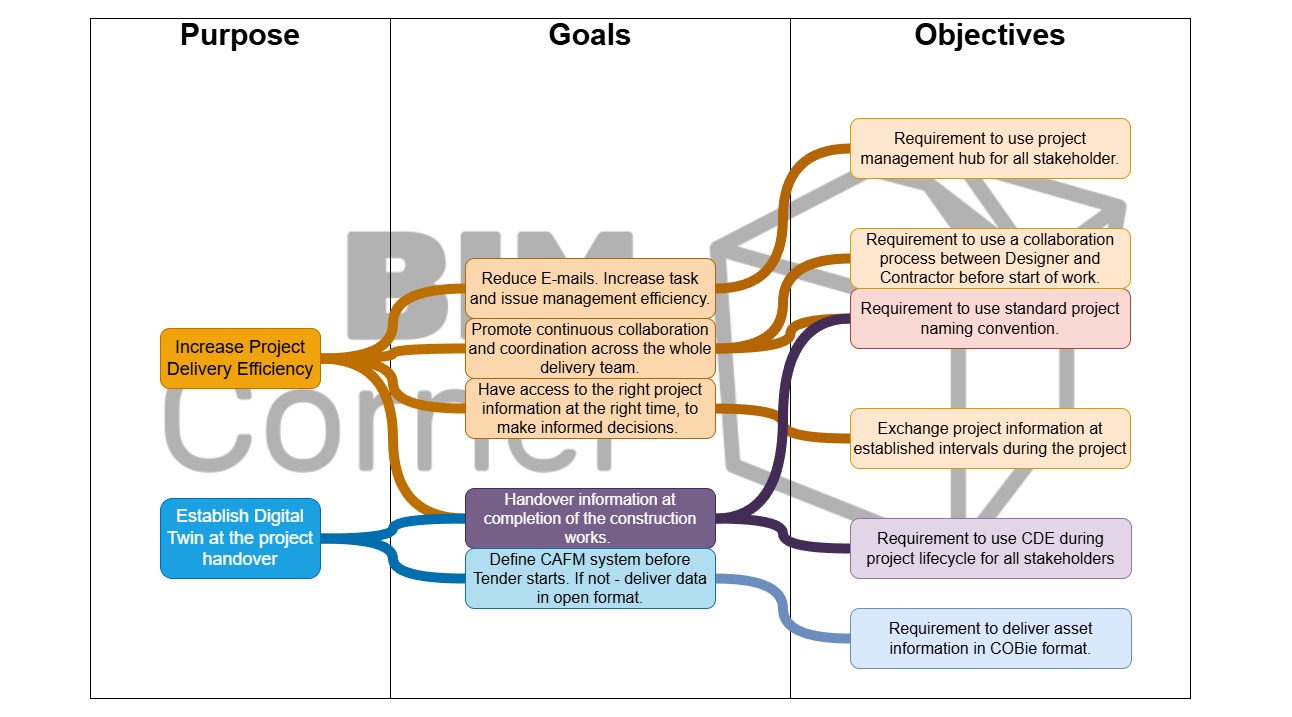
How to structure BIM requirements
To make sure everyone understands your requirements, you must specify exactly how and when to deliver the data.
Only ask for information you actually plan to use. Anything extra is a waste of time and money.
I recommend structuring your requirements in linked tables. For small projects, a spreadsheet works fine. For large, complex assets, use a database. This prevents duplicate requirements and keeps your documents clean.
Avoid empty marketing terms. Words like "Digital Twin," "Golden Thread," or "BIM 5D" mean different things to different people. Break these terms down into specific, measurable technical tasks.
Defining the data
Depending on your goals, you will receive structured or unstructured data. Structured data includes specific property sets, for the purpose of the COBie delivery. Unstructured data might be a PDF manual for the purpose of creating AIM or drone footage of the site for the purpose of visual tracking of the construction progress.
For every requirement, specify:
- The container type (model, spreadsheet, document)
- The file format (IFC, XLSX, PDF)
- The target (objects, attributes, files)
Make sure you cover both geometric details and alphanumeric data. You can read my guide on structuring property requirements here.
BIM acceptance criteria
Clear BIM acceptance criteria protect both sides. The contractor knows exactly what to deliver, and the client knows exactly how to check it.
When you structure your criteria, you can automate your quality checks. Your criteria should cover:
- Correct file naming and syntax
- Correct metadata (data types, units, values)
- Model quality and coordination rules
- Unified classification systems
What is next?
The concepts we discussed today are just the introductory concepts of an EIR. They do not represent a final table of contents, but they give you the foundation you need to start planning.
In the next post of this series, I will tackle the Level of Information Need (LOIN). This is the recommended framework to specify the quality, quantity and granularity of information requirements. In other words - all what we have talked about above.
I will show you why ISO 19650 replaces old LOD metrics, and how to write precise requirements that do not bloat your models.
See you in part two.
And remember that if you need a hand on creating or validating your EIR, you can always ask us for help: BIM Corner Services.
Resources
- ISO 19650 part 1 and 2
- Information Management Initiative Framework